A field guide for meeting shelter pets
Dog & Cat Body Language
Read the animal before you say hello.
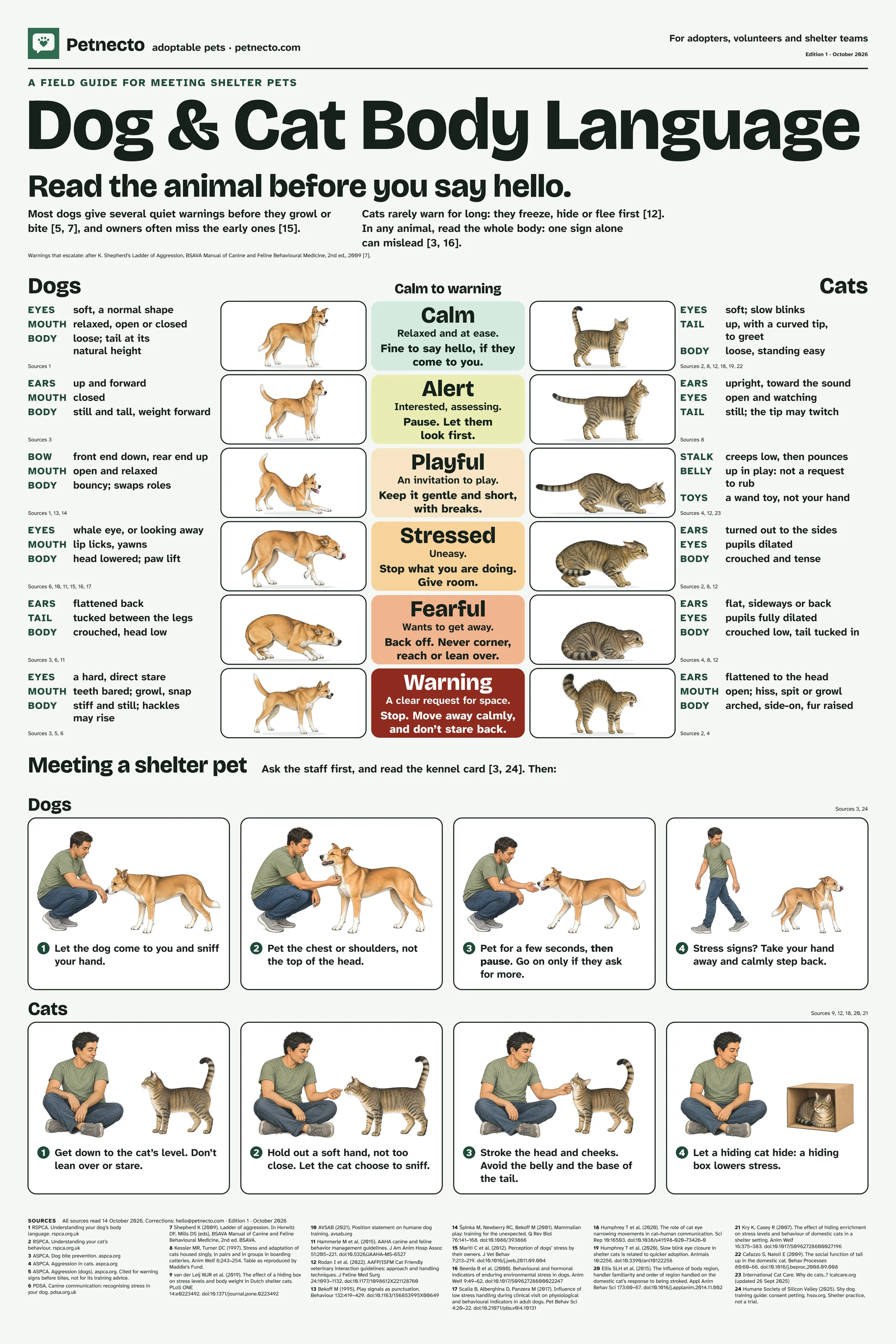
Six states, calm to warning
Read the whole body over a few seconds, not one sign. When in doubt, give space and let them choose.
Calm
Relaxed and at ease.
Fine to say hello, if they come to you.

Dogs
- Eyes
- soft, a normal shape
- Mouth
- relaxed, open or closed
- Body
- loose; tail at its natural height
Source 1
Alert
Interested, assessing.
Pause. Let them look first.


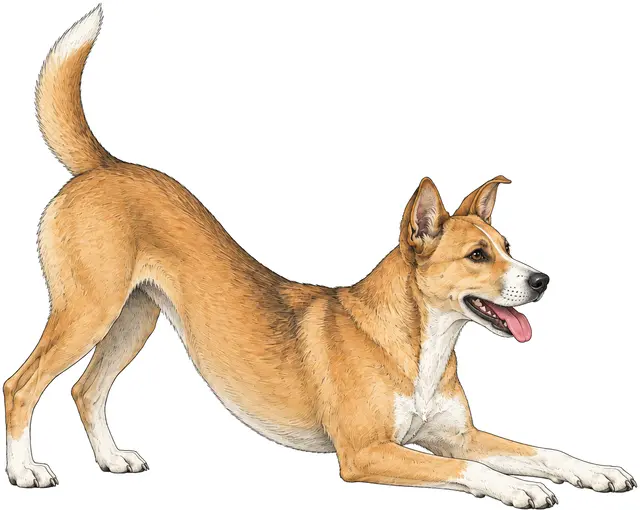
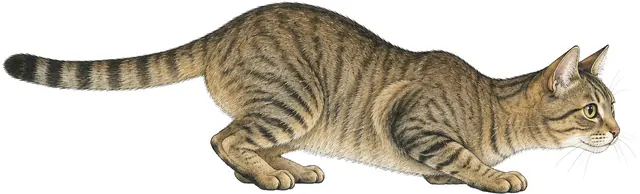
Playful
An invitation to play.
Keep it gentle and short, with breaks.
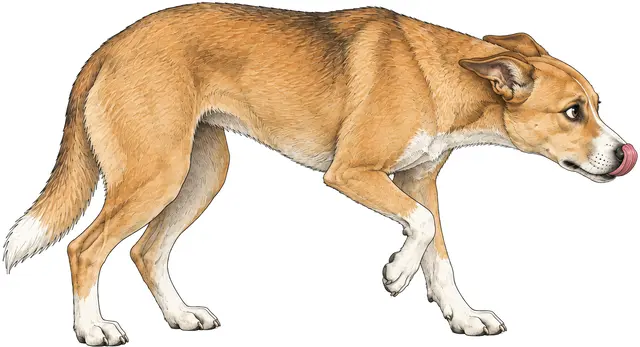
Stressed
Uneasy.
Stop what you are doing. Give room.
Fearful
Wants to get away.
Back off. Never corner, reach or lean over.
Warning
A clear request for space.
Stop. Move away calmly, and don’t stare back.



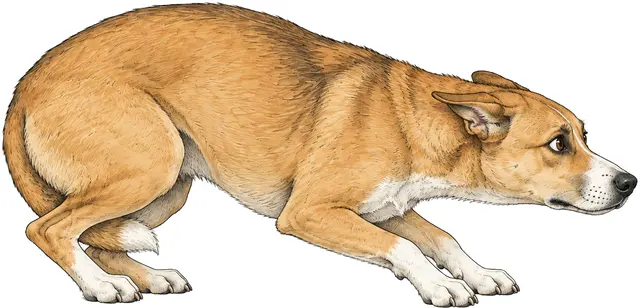
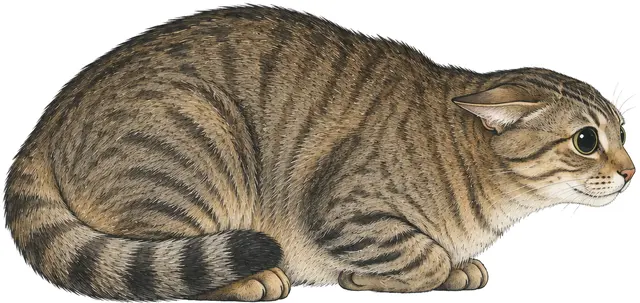

Warnings that escalate: after K. Shepherd’s Ladder of Aggression, BSAVA Manual of Canine and Feline Behavioural Medicine, 2nd ed., 2009 [7].
Meeting a shelter pet
Ask the staff first, and read the kennel card [3, 24]. Then:
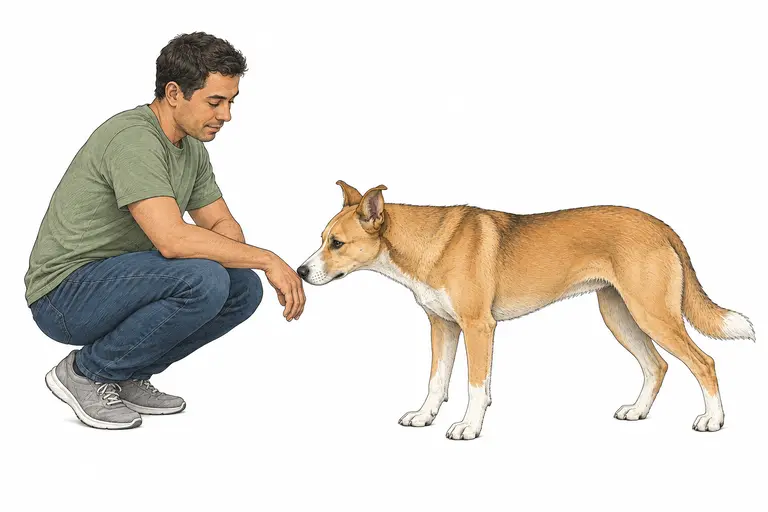
Let the dog come to you and sniff your hand. 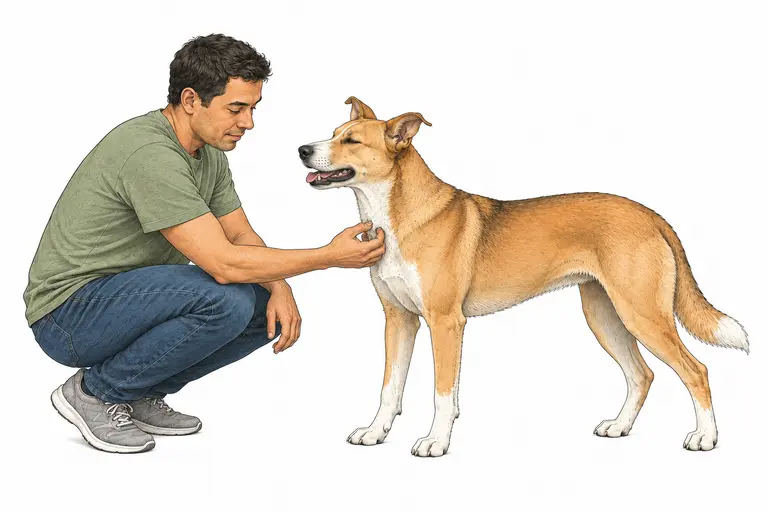
Pet the chest or shoulders, not the top of the head. 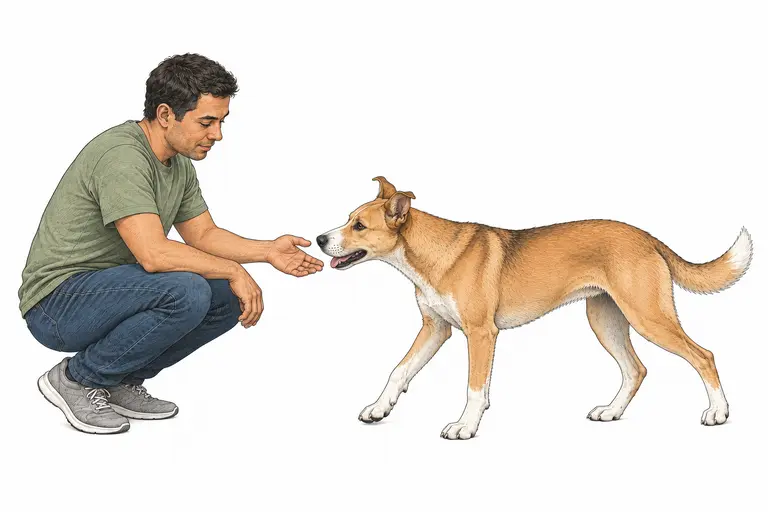
Pet for a few seconds, then pause. Go on only if they ask for more. 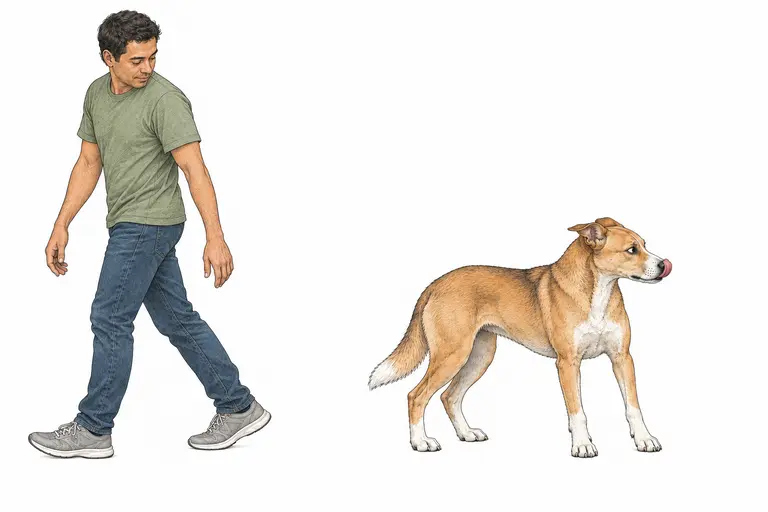
Stress signs? Take your hand away and calmly step back.
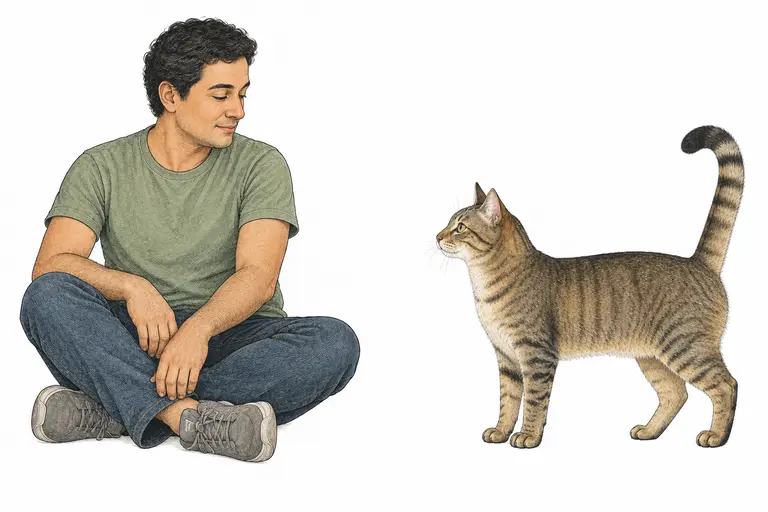
Get down to the cat’s level. Don’t lean over or stare. 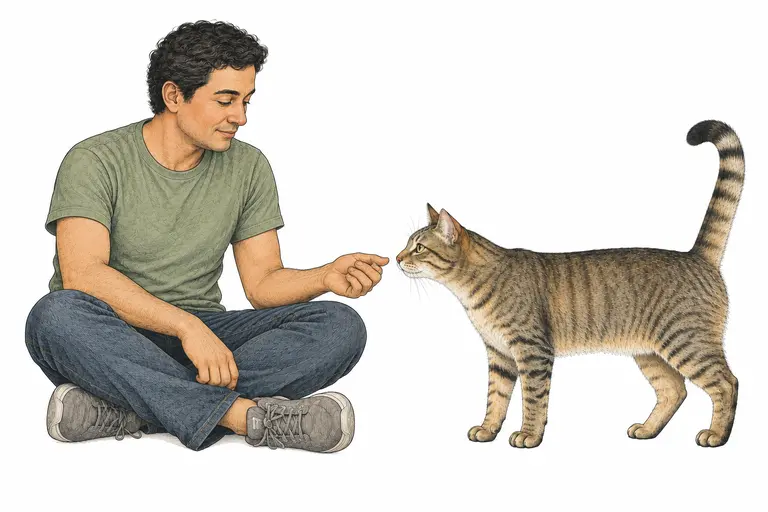
Hold out a soft hand, not too close. Let the cat choose to sniff. 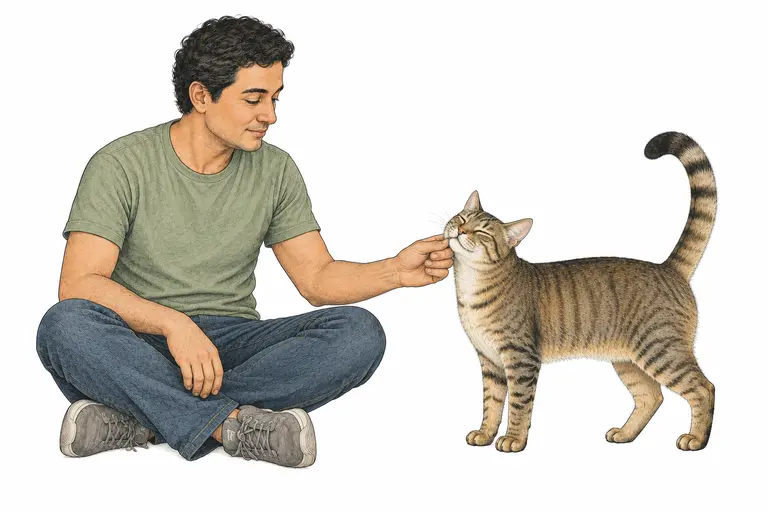
Stroke the head and cheeks. Avoid the belly and the base of the tail. 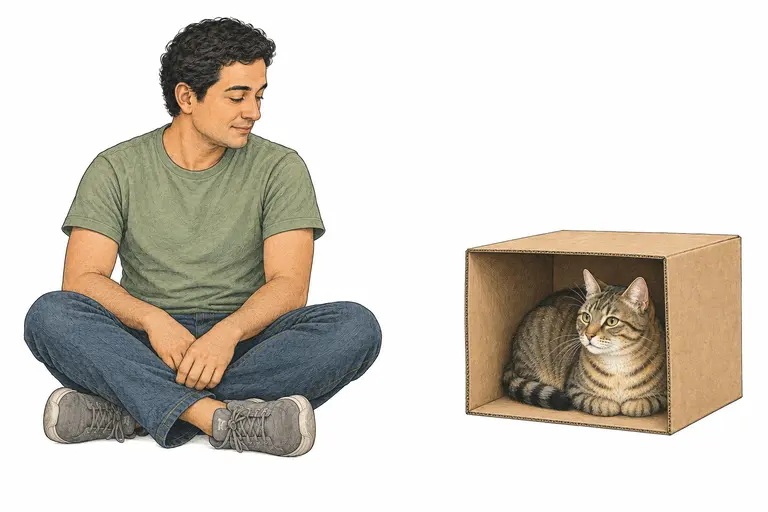
Let a hiding cat hide: a hiding box lowers stress.
The illustrations are our own, made with an image model from reference photographs and checked against the sources below.
For publishers, shelters and trainers
Shelters, rescues and trainers
Print it for your kennels, your volunteers and your adopters. A print shop needs the PDF with bleed; a home printer, the plain one.
Publishers and teachers
The print files, the editable vectors and all 20 illustrations are on one page, with sizes. Please print the credit line with them:
© Petnecto (petnecto.com). Reproduced with permission.
Questions or corrections
A different size, a translation, or a source we should read? Write to hello@petnecto.com. A person reads every message.
Sources
All sources read 14 October 2026. Edition 1 · October 2026.
- RSPCA. Understanding your dog’s body language. rspca.org.uk
- RSPCA. Understanding your cat’s behaviour. rspca.org.uk
- ASPCA. Dog bite prevention. aspca.org
- ASPCA. Aggression in cats. aspca.org
- ASPCA. Aggression (dogs). aspca.org. Cited for warning signs before bites, not for its training advice.
- PDSA. Canine communication: recognising stress in your dog. pdsa.org.uk
- Shepherd K (2009). Ladder of aggression. In Horwitz DF, Mills DS (eds), BSAVA Manual of Canine and Feline Behavioural Medicine, 2nd ed. BSAVA.
- Kessler MR, Turner DC (1997). Stress and adaptation of cats housed singly, in pairs and in groups in boarding catteries. Anim Welf 6:243–254. Table as reproduced by Maddie’s Fund.
- van der Leij WJR et al. (2019). The effect of a hiding box on stress levels and body weight in Dutch shelter cats. PLoS ONE 14:e0223492. doi:10.1371/journal.pone.0223492
- AVSAB (2021). Position statement on humane dog training. avsab.org
- Hammerle M et al. (2015). AAHA canine and feline behavior management guidelines. J Am Anim Hosp Assoc 51:205–221. doi:10.5326/JAAHA-MS-6527
- Rodan I et al. (2022). AAFP/ISFM Cat Friendly veterinary interaction guidelines: approach and handling techniques. J Feline Med Surg 24:1093–1132. doi:10.1177/1098612X221128760
- Bekoff M (1995). Play signals as punctuation. Behaviour 132:419–429. doi:10.1163/156853995X00649
- Špinka M, Newberry RC, Bekoff M (2001). Mammalian play: training for the unexpected. Q Rev Biol 76:141–168. doi:10.1086/393866
- Mariti C et al. (2012). Perception of dogs’ stress by their owners. J Vet Behav 7:213–219. doi:10.1016/j.jveb.2011.09.004
- Beerda B et al. (2000). Behavioural and hormonal indicators of enduring environmental stress in dogs. Anim Welf 9:49–62. doi:10.1017/S0962728600022247
- Scalia B, Alberghina D, Panzera M (2017). Influence of low stress handling during clinical visit on physiological and behavioural indicators in adult dogs. Pet Behav Sci 4:20–22. doi:10.21071/pbs.v0i4.10131
- Humphrey T et al. (2020). The role of cat eye narrowing movements in cat–human communication. Sci Rep 10:16503. doi:10.1038/s41598-020-73426-0
- Humphrey T et al. (2020). Slow blink eye closure in shelter cats is related to quicker adoption. Animals 10:2256. doi:10.3390/ani10122256
- Ellis SLH et al. (2015). The influence of body region, handler familiarity and order of region handled on the domestic cat’s response to being stroked. Appl Anim Behav Sci 173:60–67. doi:10.1016/j.applanim.2014.11.002
- Kry K, Casey R (2007). The effect of hiding enrichment on stress levels and behaviour of domestic cats in a shelter setting. Anim Welf 16:375–383. doi:10.1017/S0962728600027196
- Cafazzo S, Natoli E (2009). The social function of tail up in the domestic cat. Behav Processes 80:60–66. doi:10.1016/j.beproc.2008.09.008
- International Cat Care. Why do cats..? icatcare.org (updated 26 Sept 2025)
- Humane Society of Silicon Valley (2025). Shy dog training guide: consent petting. hssv.org. Shelter practice, not a trial.